Who owns the trees on a farm? Who benefits from forest resources? And what responsibilities come with these rights?
These are questions many farmers, plantation developers, and forest fringe communities in Ghana continue to ask. Understanding forest tenure laws and benefit-sharing arrangements can be difficult, especially when information is written in complex legal language.
To help close this knowledge gap, Knowledge for World Conservation (KWC) has developed two simplified guidebooks under the FAO-funded Restoration for Resilience and Recovery (3R) of Sustainable Agri-Food Systems Project. These new resources aim to make forest tenure information easier to understand and use in everyday decision-making.
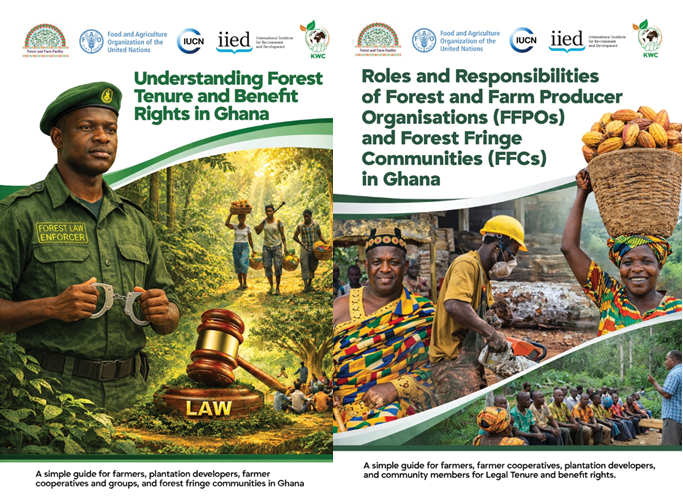
The two guidebooks — Understanding Forest Tenure and Benefit Rights in Ghana and Roles and Responsibilities of Forest and Farm Producer Organisations (FFPOs) and Forest Fringe Communities (FFCs) in Ghana — were created to support the people who interact most with forests and trees.
These include farmers, plantation developers, farmer cooperatives, producer groups, and forest fringe communities. Written in simple sentences and supported with illustrations and infographics, the guidebooks turn complex rules into clear, practical steps. They help stakeholders understand not only their rights, but also the responsibilities that help keep forests productive and communities protected.
The first guidebook, Understanding Forest Tenure and Benefit Rights in Ghana, focuses on the question of ownership and benefits. It explains who owns land and forest resources in Ghana and why naturally growing trees are often managed differently from planted trees. It also shows farmers how to register trees, why keeping records is important, and how benefit-sharing works under timber, plantation, and carbon projects.
The guide further explains legal safeguards, helping farmers and communities know what actions to take when their rights are ignored or when damage occurs to farms and trees.
The second guidebook, Roles and Responsibilities of Forest and Farm Producer Organisations (FFPOs) and Forest Fringe Communities (FFCs) in Ghana, focuses on working together responsibly. It shows the roles of traditional authorities, farmer cooperatives, private sector actors, and community members. It highlights the importance of Social Responsibility Agreements (SRAs) and shows how communities can actively participate in negotiations and monitor agreed benefits.
The guide also explains responsibilities related to legal compliance and sustainable practices, such as preventing bushfires, reporting illegal logging, and ensuring fair participation of women and youth.
Together, these guidebooks provide practical tools that can be used at the community level. Farmers can use them to better understand tree ownership and protect their farms. Producer organizations can use them to guide members during negotiations and record keeping. Plantation developers can use them to better understand their obligations to communities and environmental standards. Finally, it will also help communities move from uncertainty to confidence when dealing with forest-related issues.